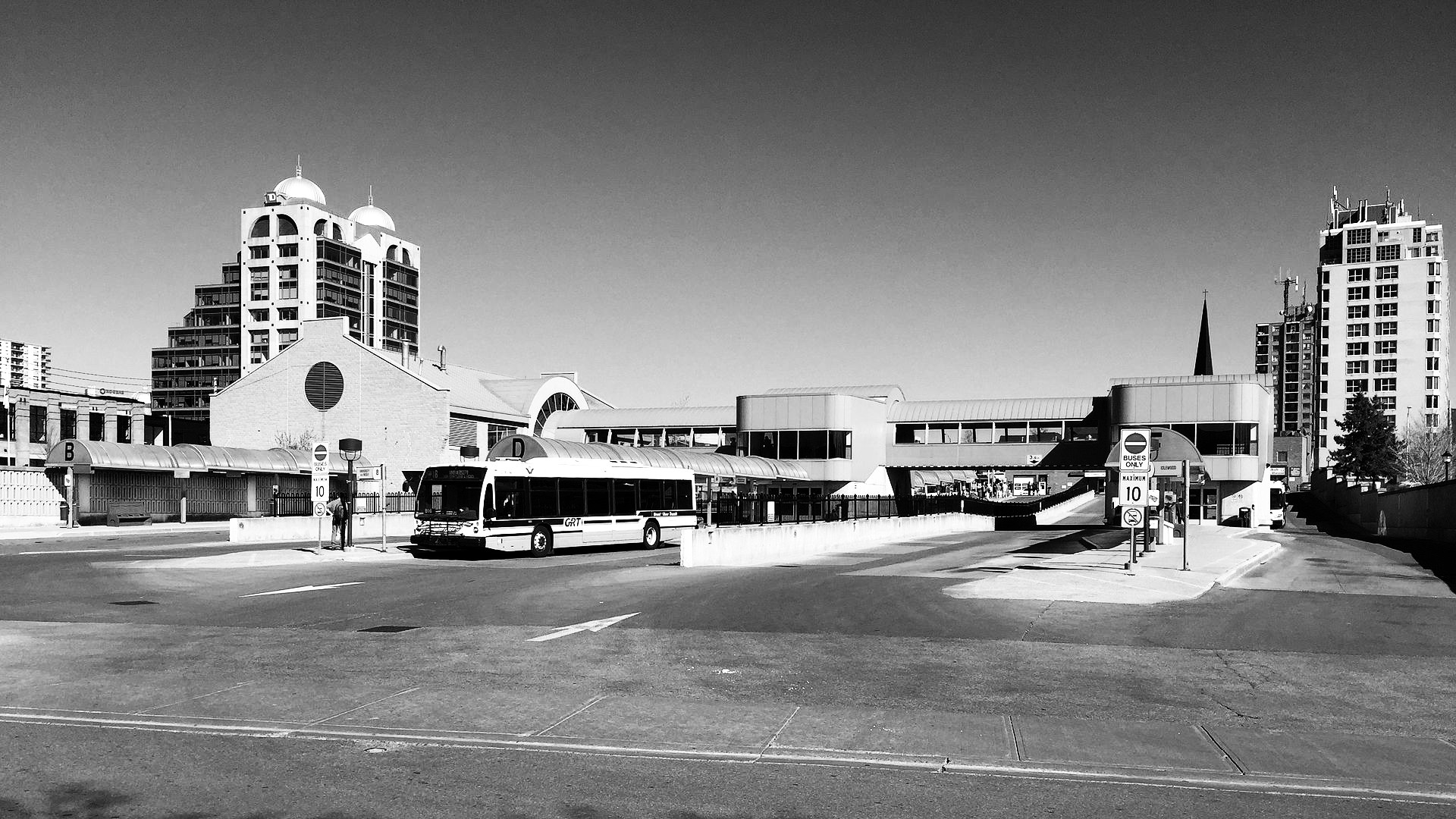
A CLT in Downtown Kitchener led by Indigenous and marginalized folks.
wHAT IS A COMMUNITY LAND TRUST?
A community land trust (CLT) is a not-for-profit, democratically governed and community-based land stewardship organization.
Due to the failure at all levels of government to provide sufficient affordable housing, workspaces, cultural and community spaces, we are following the lead of many other Canadian communities who have started Community Land Trusts in response to this crisis.
What is our mission?
BRING LAND AND HOMES INTO COMMUNITY STEWARDSHIP IN DOWNTOWN KITCHENER
Our community urgently needs new ways to halt the gentrification of Downtown Kitchener.
•
The initial CLT activities will focus on stewarding the land and future buildings at the Charles Street Bus Terminal site, with the potential to expand across Kitchener-Waterloo in the future, depending on our team capacity, funding and opportunity.
CREATE JUST, ACCESSIBLE AND AFFORDABLE SPACES
The CLT Model will allow us to prioritize community needs over profit motives, and will support affordable housing, affordable retail and office space for local businesses and nonprofits, spaces for education, local arts and culture, carework, community gardens and more.
PRIORITIZE INDIGENOUS AND MARGINALIZED LEADERSHIP
It is a priority for Willow River CLT to ensure that Indigenous, Black, Queer and other marginalized voices with lived experience of housing injustice remain at the forefront. This is because these communities are disproportionately affected by the housing and affordability crises.
The Charles Street
Bus Terminal
Willow River Community Land Trust will build on the work that has been done surrounding the Charles Street Bus Terminal site.

The Challenge
A critical location
We see this land at the former Charles Street Bus Terminal as an extension of Willow River Park, which has been a site of cultural and economic exchange between Nations, starting with the First Peoples, the Haudenosaunee, the Anishinaabe and the Chonnoton peoples, for generations.
The site is also located on the Haldimand Tract, which was promised to the Six Nations of the Grand River.
A lack of affordable housing and community space for marginalized communities
Since 2021, we have called on the Region to honour the treaties and return the Charles Street Bus Terminal land to Indigenous-led, non-market stewardship, through a collaborative process with Indiegnous and other marginalized communities in downtown Kitchener.
This is an important step in halting the gentrification of Downtown Kitchener and ensuring that Downtown Kitchener remains accessible for equity-deserving communities to live, work and play.
a lack of transparency
To date, there has been a lack of transparency and many delays in the Region’s consultation process.
Recollections and Imaginings

work done to date
a vision document
We created a vision document with diagrams and renderings to support conversations with the Region of Waterloo about a Community Hub at the Charles Street Bus Terminal Site.
A petition
We set up a petition on change.org to garner community support for LandBack at the Charles Street Bus Terminal site. Almost 3700 people signed the petition.
Building relationships
We have attended the official community consultation sessions with the Region of Waterloo staff and consultants. We have also built relationships with partners who have skills that can support our vision for non-market housing and community space.
a documentary
We created the “Recollections and Imaginings” documentary, which documents our grassroots community consultation on the hisotry and future of the bus terminal.
These conversations demonstrated that continuing in the ethos of the former bus terminal as a place of connection and exchange for low-income, disabled, queer, Black, Indigenous and Racialized and unhoused community members is widely supported by the community.
Board of directors
Bangishimo
(they/them) Co-founder of Willow River Centre and Landback Camp, Professor
Amy Smoke
(they/them) Co-founder of Willow River Centre and Landback Camp, Professor
Niara Plet
Niara (she/her) is an artist and designer of Afro-Surinamese Creole and Dutch descent. She sees design as a tool for social and environmental justice, and is passionate about community-stewarded land and housing. Niara grew up on the Haldimand Tract in the watershed of Willow River, in what is now called Kitchener, and completed her undergraduate degree at the University of Waterloo. She has worked in sustainability consulting, urban design and architecture at firms from Vancouver to Amsterdam. Combining her technical skills with a collaborative approach to project coordination and public engagement, Niara has been involved in many grassroots initiatives for a more just and equitable world.
Elfie Kalfakis
Elfie Kalfakis (she/her/they) is a multidisciplinary artist, educator, and intuitive practitioner whose work explores the intersections of creativity, healing, and collective care. With a background in architecture and a deep commitment to community engagement, she brings a thoughtful, systems-aware perspective. Elfie’s practice is rooted in exploring themes of trauma healing, empowerment, and social change which led her to join the Willow River CLT Board of Directors.
Lenny Sweeney
Paniz Moayeri
Paniz (she/her) is a licensed architect with a career bridging practice, research, and advocacy, with a focus on the social, ethical, and cultural dimensions of built spaces and design. She has over seven years of professional experience across offices in Toronto, Dubai, Victoria, New York, and Kitchener, working on a wide range of building types, delivery models, and design stages. Skilled in community consultation and multi-stakeholder engagement, Paniz is a strong advocate for participatory, community-led design.
Paniz’s award-winning thesis, Your Passport Doesn’t Work Here, explores the intersection of architecture, identity, and Iranian queer heritage. Her writing appears in Canadian Architect, JSSAC, and The Signs That Define Toronto. She has taught design studio at Laurentian University, assisted courses at Waterloo Architecture, and served as a guest lecturer and critic at TMU and Carleton.
As a co-founder of Treaty Lands, Global Stories, Paniz has advocated for recognizing Canada’s Indigenous heritage and broadening architectural education beyond Western paradigms since 2016. She is a former Advisory Board Member to Waterloo Architecture’s Racial Equity and Environmental Justice Task Force, and an active member of the Architecture Lobby, where she advocates for equity and improved working conditions in the profession. Paniz is the current secretary for the Grand River Society of Architects’ Executive Committee.
Maddie Resmer
Maddie Bernard-Resmer (they/them) is a mixed-Anishinàbe and Two-Spirit artist and advocate; owner of Western Sky Designs; one of the original members of the O:se Kenhionhata:tie Land Back Camp occupation; and SHORE Centre’s Manager of Communications. Maddie’s maternal family comes from Pìkwakanagàn First Nation (Bernard) and Kitigan-Zibi First Nation (Beaudoin/Commanda), and they live in Kitchener, Ontario (Haldimand Tract Treaty Territory).
Benny Skinner
Benny Skinner (they/them) is a Two Spirit thinker, educator and creator from Ktaqmkuk and Luzon. They are currently a fellow and PhD, Global Governance student at the Balsillie School of International Affairs, where they study colonialism and information governance. They also work as a sessional lecturer at St. Jerome’s University, a consultant at ShiftWork consulting, and have been a professional human rights advocate for over a decade.
Our Supporters
We wish to thank our founding organizational members for their support:
Community Justice Initiatives
Social Development Centre Waterloo Region
Shore Centre
Spectrum
Inter Arts Matrix
MT Space
Kind Minds Family Wellness
Willow River Centre
Contact Willow River CLT
Willow River Centre welcomes neighbors, leaders, and supporters to join in building a community land trust that centers Indigenous, Black, Queer, and marginalized folks. Contact Us: willowriverclt.@gmail.com
